
Many students make the fatal mistake of thinking, “I speak English well, so I don’t need to study.” This is why so many learners fall from 80% in Grade 11 to 60% in Matric.
Grade 12 English Home Language (HL) is not about fluency; it is about critical analysis. It tests your ability to deconstruct propaganda, argue complex philosophical points, and appreciate the subtle mechanics of literature.
I have broken down the curriculum below, not just to show you what is in the papers, but to show you exactly how to answer the questions to get those distinction marks.
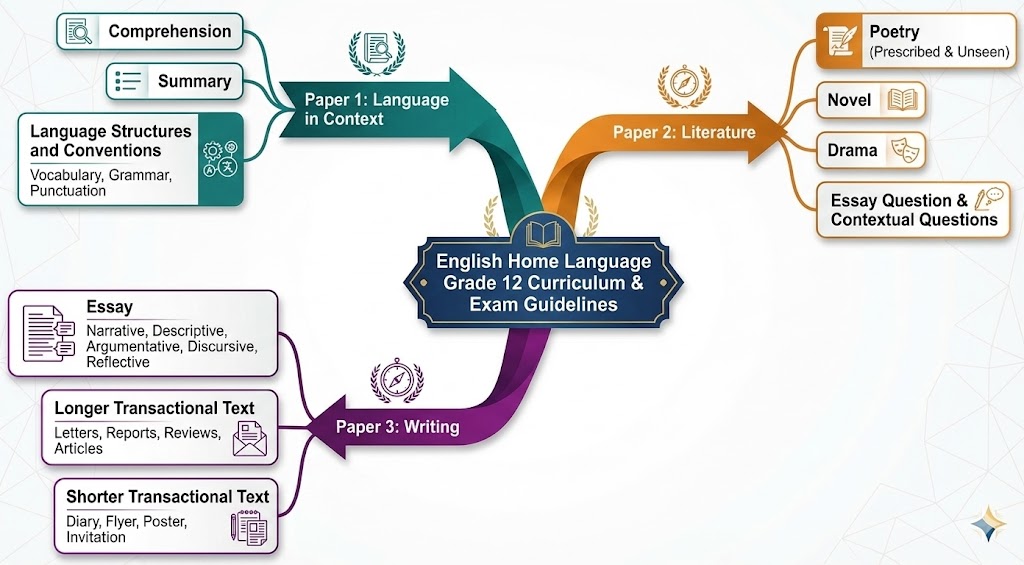
Paper 1: Language in Context (70 Marks)
This paper tests your analytical skills. You need to read “between the lines.”
1. Comprehension (30 Marks)
This is usually a challenging article (often an opinion piece or argumentative text).
- Tone & Style: The most common question asks: “Identify the tone of the writer.”
- The Trap: Answering with one vague word like “angry.”
- The Fix: Be specific. Is the writer satirical? Condescending? Nostalgic? Look at the adjectives they use. If they call a politician “spineless,” the tone is critical and assertive.
- The “Evaluative” Question: You will be asked, “Do you agree with the writer’s view?”.
- Tip: The examiner does not care about your personal opinion. They care about your ability to evaluate the argument. You must say: “Yes, the writer’s argument is valid because he provides statistics to back up his claim…” or “No, the argument is biased because…”
2. Summary (10 Marks)
- The Golden Rule: You must summarize the text in fluent paragraph form, not bullet points.
- The Word Count: You have strictly 90 words. If you write 100 words, the marker stops reading at 90. Anything after that—even if it is the correct answer—gets zero.
- The Strategy:
- Highlight the 7 main points in the text.
- Rewrite them in your own words (one sentence each).
- Combine them into a paragraph using linking words (However, Therefore, Furthermore).
3. Language Structures & Conventions (30 Marks)
This section tests advanced grammar and visual literacy.
- Advertising: When analyzing an ad, look at the “AIDA” principle: Attention, Interest, Desire, Action. How does the image grab attention? How does the text create desire?
- Cartoons: Humor usually comes from Irony (saying one thing but meaning another) or Stereotypes. If you are asked to explain the humor, simply describe the contrast between what we expect to happen and what actually happens.
- Editing: You will need to correct a short text. Look out for “Malapropisms” (using a word that sounds similar but is wrong, like “pacific” instead of “specific”) and Concord errors (subject-verb agreement).
Paper 2: Literature (80 Marks)
You need to know your setworks in extreme detail. You will answer on Poetry, Novel, and Drama.
1. Poetry (30 Marks)
- Prescribed Poems: You will answer detailed questions on two poems you have studied. Focus on Diction (why did the poet choose that specific word?) and Imagery (metaphors and similes).
- The Unseen Poem: This scares everyone, but it shouldn’t. Use the TP-CASTT method to break it down:
- Title: What does it suggest?
- Paraphrase: Translate the poem into modern English.
- Connotation: Look for hidden meanings.
- Attitude: What is the poet’s emotion?
- Shift: Where does the mood change?
- Title: Look at it again—does it mean something new now?
- Theme: What is the message?
2. The Novel (25 Marks)
- The Literary Essay: You will write a rigorous argumentative essay (400–450 words) on a theme, such as “Betrayal in The Great Gatsby” or “Innocence in The Life of Pi.”
- Structure is King: You need a strong introduction with a clear thesis statement. Every paragraph that follows must support that thesis with evidence (quotes or specific scenes) from the text.
- Don’t Retell the Story: The marker knows the plot. Do not tell them what happened; tell them why it matters.
3. The Drama (25 Marks)
- Contextual Questions: These are based on an extract from your play (usually Hamlet or Othello).
- Dramatic Irony: This is a favorite exam topic. It occurs when the audience knows something the characters don’t (e.g., we know Iago is evil, but Othello calls him “Honest Iago”).
- The Soliloquy: When a character speaks to themselves, it is a window into their soul. Always analyze a soliloquy as a moment of “inner conflict.”
Paper 3: Writing (100 Marks)
This is where you show off your style and flair.
1. The Essay (50 Marks)
You can choose between Narrative, Descriptive, Reflective, or Argumentative essays.
- The “Hook”: Your first sentence must grab the marker by the throat. Avoid boring starts like “One day I woke up…” Instead, try: ” The gun was heavier than it looked.”
- Show, Don’t Tell: Don’t say “I was scared.” Say “My hands trembled and my throat went dry.”
2. Transactional Writing (2 x 25 Marks)
You will write two texts (e.g., Letter to the Editor, Review, Obituary, or Speech).
- Register is Key: A formal letter must be cold and polite. A review can be witty and semi-formal. A speech must use rhetorical devices (repetition, questions).
- Format: Marks are lost easily here. Ensure you know exactly where the dates, addresses, and subject lines go for every single format.
Decksh’s Top 3 Tips for a Distinction
1. Vocabulary is Key
In Home Language, using basic words like “good” or “bad” won’t cut it. You need to upgrade your vocabulary to sound sophisticated.
- Instead of “Bad,” use “Detrimental,” “Egregious,” or “Catastrophic.”
- Instead of “Show,” use “Illustrate,” “Depict,” or “Epitomize.”
2. Master the “Critical Discussion”
In Papers 1 and 2, you will be asked to “Critically discuss.” This is not a “Yes/No” question.
- The Method: You must look at both sides. Weigh the evidence.
- Example: “While Hamlet’s actions seem mad, one could argue they are a calculated strategy to confuse the King.”
3. Time Management in Paper 2
The Literature paper is intense. Students often spend 40 minutes on the poetry section and run out of time for the essay.
- The Rule: Allocate time strictly based on marks. 1 mark = 1 minute. If the poetry section is 30 marks, you spend 30 minutes. Not a second more.
Conclusion
English Home Language requires you to be a critical thinker. Don’t just read the text; interrogate it. Why did the author use that specific adjective? What is the hidden bias? If you ask these questions, you will succeed.
Good luck with your Matric Finals!