
Grade 12 English First Additional Language (FAL) is the final test of your ability to communicate in the real world. Many students think they can just “wing it” because they speak English with their friends. This is a mistake.
The examiners are not testing your slang; they are testing your precision. Can you switch a sentence from Active to Passive voice without losing the meaning? Can you write a formal letter that would actually get you a job?
This guide breaks down the curriculum based on the Examination Guidelines, showing you exactly where the marks are hidden.
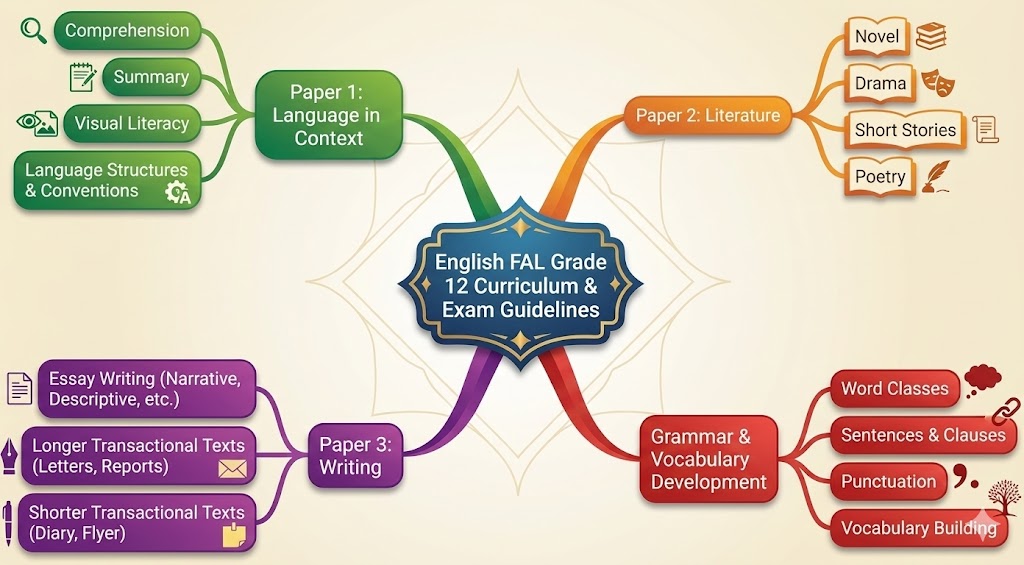
Paper 1: Language in Context (80 Marks)
This paper tests your ability to understand texts and apply grammar rules. It is high-paced, so strategy is key.
1. Comprehension (30 Marks)
This is usually a magazine article or newspaper report.
- The “Own Words” Rule: When a question asks you to answer “in your own words,” looking at the text and copying it is a death sentence.
- The Fix: Read the sentence, look away from the page, and explain it to yourself like you are talking to a 5-year-old. Write that down.
- Mark Allocation: Watch the marks at the end of the question.
- 2 Marks: You need a Statement + a Reason.
- 1 Mark: You need a direct answer (Yes/No or a Quote).
- Scanning: Read the questions before you read the text. This gives your brain a “search mission” so you know what to look for.
2. Summary (10 Marks)
You will be asked to summarize a text into 7 points.
- The “Highlighter” Method: Read the text and highlight the 7 sentences that directly answer the prompt. Ignore examples, repetitions, and adjectives.
- The Draft: You must write a rough draft first. Cross out the fancy words.
- Original: “The exhausted runner collapsed on the soft green grass.”
- Summary: “The runner fell.”
- Word Count: You must indicate the correct word count (max 70 words). If you lie, the markers will count, and they will penalize you.
3. Language Structures & Conventions (40 Marks)
This section is pure “Maths with words.” There is always a right and wrong answer.
- Visual Literacy: You will analyze a cartoon or advertisement.
- Target Audience: Who is this ad for? Don’t just say “people.” Say “Health-conscious teenagers” or “Business owners.”
- AIDA Principle: Attention (bold font), Interest (image), Desire (promises), Action (“Call now!”).
- The “Big 3” Grammar Rules:
- Passive Voice: The object moves to the front.
- Active: “The dog bit the boy.”
- Passive: “The boy was bitten by the dog.” (Don’t forget the verb to be).
- Reported Speech (Indirect Speech): This is where most marks are lost. You must change three things:
- Pronouns: “I” becomes “He/She.”
- Tense: Go back one step (Present → Past; Past → Past Perfect).
- Time words: “Tomorrow” becomes “the next day”; “Here” becomes “there.”
- Concord: Subject-verb agreement. “The group of boys is playing.” (The subject is “group” [singular], not “boys”).
- Passive Voice: The object moves to the front.
Paper 2: Literature (70 Marks)
You need to know your setworks inside out. You will answer questions on a Novel, Drama, Short Stories, or Poetry.
1. The Literature Essay (Novel/Drama) (25 Marks)
This is a long essay (250 words) on a theme or character.
- The PEEL Method: Structure your paragraphs like this to guarantee marks:
- Point: Make a statement (e.g., “Macbeth is driven by ambition”).
- Evidence: Give an example from the story.
- Explanation: Why does this matter?
- Link: Connect it back to the question.
- Quotes: You don’t need to memorize whole pages, but knowing short, powerful quotes (e.g., “Fair is foul, and foul is fair”) impresses the marker.
2. Contextual Questions (Short Questions)
These are based on an extract printed in the exam paper.
- Place the Extract: The first question is usually: “Describe the events leading up to this extract.” You need to know exactly where in the timeline this scene happens (Beginning, Climax, or Resolution).
- Character Motives: Why did the character say that? Look at their subtext (hidden feelings).
3. Poetry (Seen and Unseen)
- Figures of Speech: Don’t just identify a Metaphor or Simile. You must explain why it is used.
- Formula: “The poet compares [Object A] to [Object B] to show that…”
- Tone vs. Mood:
- Tone: The poet’s attitude (Angry, Sarcastic).
- Mood: How the poem makes you feel (Sad, Hopeful).
Paper 3: Writing (100 Marks)
This paper is where you can score high marks if you follow the strict formats.
1. Essay Writing (50 Marks)
- Narrative Essay: Telling a story. This is usually the safest choice for FAL students. Focus on a clear plot: Introduction → Complication → Climax → Resolution.
- Descriptive Essay: Painting a picture with words. Use your 5 senses (Sight, Sound, Smell, Touch, Taste).
- Discursive Essay: Discussing both sides of an issue. Only choose this if you have strong general knowledge.
2. Longer Transactional Texts (30 Marks)
- Formal Letter: You must know the format perfectly.
- Your Address (Top Right).
- Date (Below your address).
- Recipient Address (Left).
- Salutation (Dear Sir/Madam).
- Subject Line (UPPERCASE).
- Report: Use headings like “Terms of Reference,” “Procedure,” “Findings,” and “Conclusion.”
3. Shorter Transactional Texts (20 Marks)
- Diary Entry: Must start with “Dear Diary.” The language should be emotional and personal.
- Advertisement: Use a catchy headline, persuasive language (“Don’t miss out!”), and clear details.
Decksh’s Top 3 Tips for Distinction
1. Master the “Editing” Section
In Paper 1, Question 5 asks you to correct errors in a text. This is the easiest place to gain marks if you practice.
- Look out for Spelling mistakes (especially double letters like in “accommodation”).
- Check for Apostrophes: Is it ownership (John’s) or contraction (It’s)?
- Fix Concord errors: “One of the boys are” is wrong. It should be “One of the boys is.”
2. Learn “Tone” and “Register” Vocabulary
Examiners love asking “What is the tone of this passage?”. You cannot just say “happy” or “sad.” Use Grade 12 words:
- Instead of “Sad,” use “Somber” or “Melancholic.”
- Instead of “Happy,” use “Enthusiastic” or “Optimistic.”
- Instead of “Serious,” use “Formal” or “Objective.”
3. Planning is Essential for Paper 3
Never start writing an essay without a plan (Mind map).
- It stops you from rambling and going off-topic.
- Bonus: You actually get marks for showing your planning! Cross it out neatly before you hand it in, but leave it visible so the marker sees your thought process.
Conclusion
English FAL Grade 12 is about precision. Be precise in your grammar rules, structure your essays logically using paragraphs, and know your literature quotes. If you treat this subject with respect, it will reward you with a distinction.
Good luck with your Matric Finals!
Very helpful thank you. I love these tips