
Life Sciences (Biology) in Grade 12 is unique because it tests two very different ways of thinking. Paper 1 is about how the body works (Physiology), while Paper 2 is about origins and change (DNA and Evolution).
To get a distinction, you need more than just memorization; you need to master the art of the “biological essay” and understand how to interpret complex diagrams. This guide breaks down the CAPS curriculum to help you focus on the high-yield sections.
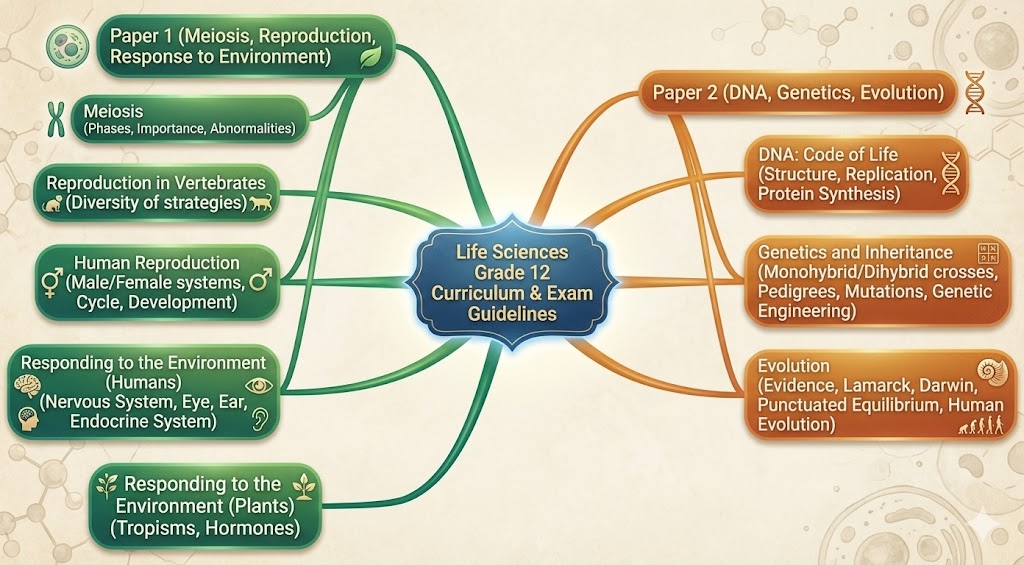
Paper 1: Life Processes in Plants and Animals (150 Marks)
This paper focuses on how organisms function and reproduce. It is technical and requires precise terminology.
1. Reproduction in Vertebrates (±8 Marks)
This section is short but often tricky. You need to understand the evolutionary trade-offs of different strategies.
- External vs. Internal Fertilization: Why do fish release millions of eggs (External)? Because the survival rate is low. Why do humans release one (Internal)? Because the survival rate is high.
- The Amniotic Egg: You must know the labels (amnion, chorion, yolk sac, allantois).
Tutor Tip: Understand the function of the amniotic egg—it allowed animals to move from water to land by preventing the embryo from drying out.
2. Human Reproduction (±41 Marks)
This is a major section.
- Hormonal Control: The Menstrual Cycle is the hardest part for most students. You need to trace the rise and fall of four hormones:
- FSH & LH: Produced in the brain (Pituitary). They control the ovary.
- Oestrogen & Progesterone: Produced in the ovary. They control the uterus lining.
- Exam Alert: If you see a graph where Progesterone stays high at the end of the cycle, the woman is pregnant. If it drops, menstruation occurs.
3. Responding to the Environment (Humans) (±54 Marks)
The Nervous System:
- The Reflex Arc: You will almost certainly be asked to draw or label this.
- Common Mistake: Students confuse the “Sensory Neuron” (has the cell body in the middle) with the “Motor Neuron” (has the cell body at the end).
The Eye & Ear:
- Focus heavily on Accommodation (how the lens changes shape to see near/far) and the Pupillary Mechanism (how the iris adjusts to bright/dim light).
The Endocrine System:
- Negative Feedback: This is the body’s “thermostat.” Understand how TSH and Thyroxin work together to keep metabolism steady.
4. Responding to the Environment (Plants) (±13 Marks)
- Tropisms: Understand how Auxins move to the dark side of a stem, causing it to grow faster and bend the plant towards the light (Phototropism).
Paper 2: Life at the Molecular, Cellular and Tissue Level (150 Marks)
This paper deals with genetics and evolution. It requires logical reasoning.
1. DNA: The Code of Life (±27 Marks)
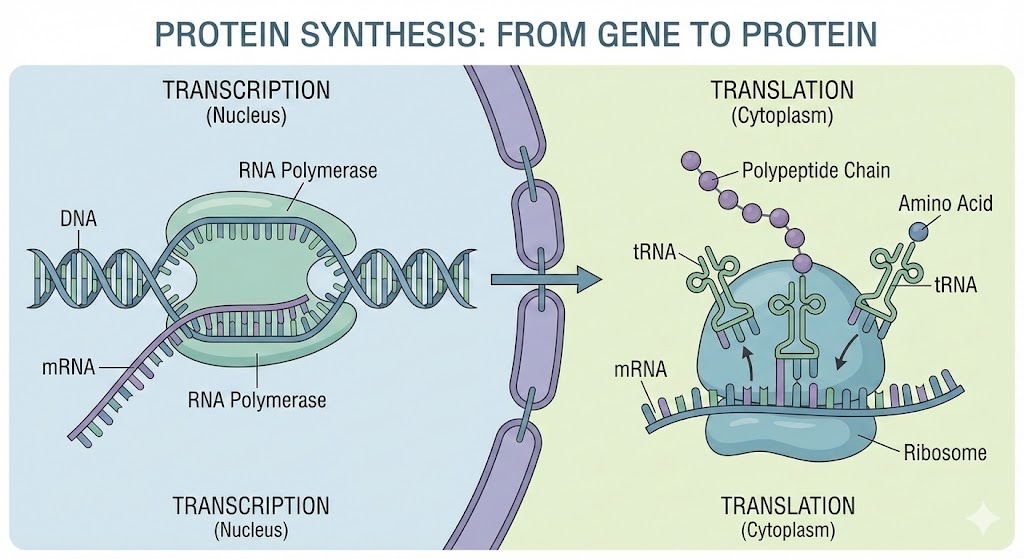
Protein Synthesis: This is often a 6-mark essay question. You cannot “wing” this. You must memorize the sequence:
- Transcription: DNA unwinds in the nucleus \rightarrow mRNA is formed.
- Movement: mRNA leaves the nucleus \rightarrow goes to the Ribosome.
- Translation: tRNA brings specific amino acids \rightarrow they bond to form a protein.
2. Meiosis (±21 Marks)
The Mistake: confusing Meiosis with Mitosis.
- Mitosis: Makes identical body cells (2n \rightarrow 2n).
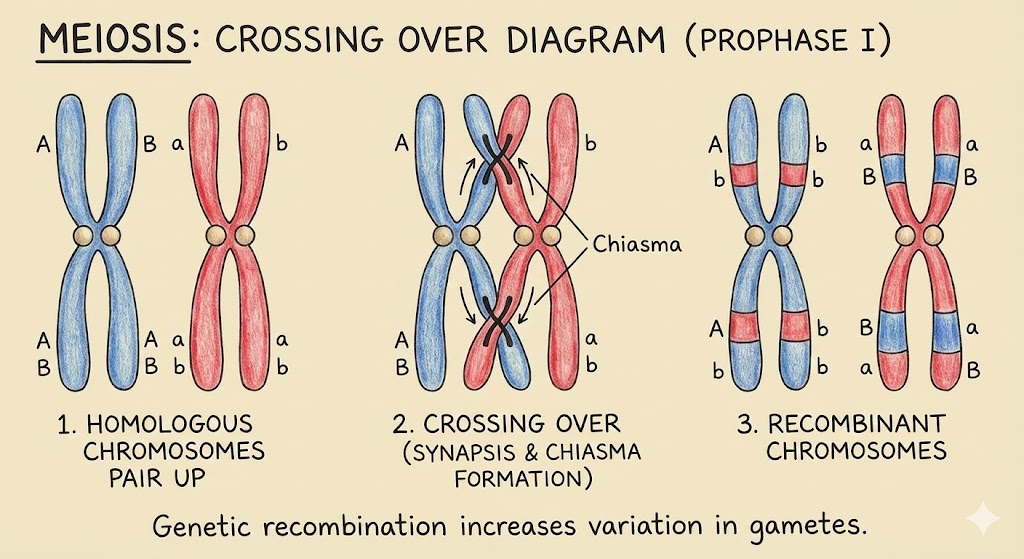
- Meiosis: Makes sperm/egg cells with half the chromosomes (2n \rightarrow n).
- Genetic Variation: Focus on Crossing Over (Prophase I) and Random Arrangement (Metaphase I). These are the reasons you look different from your siblings!
3. Genetics and Inheritance (±48 Marks)
Punnett Squares: You need to master three types of crosses:
- Monohybrid: Simple dominant/recessive.
- Sex-Linked: Haemophilia and Colour Blindness are carried on the X chromosome (X^H X^h).
- Blood Groups: Co-dominance (Type A and B are dominant over O).
- Formatting Tip: Always label P1 (Parents), Gametes, and F1 (Offspring). If you skip the labels, you lose format marks.
4. Evolution (±54 Marks)
- Theories:
- Lamarck: Thought “acquired” traits (like a giraffe stretching its neck) were passed on. (He was wrong, but you must know why).
- Darwin: Proposed Natural Selection. Those with the best traits survive and reproduce.
- Human Evolution: Focus on the skull differences between Australopithecus (ape-like) and Homo sapiens (human). Look at the Foramen Magnum—if it is at the bottom of the skull, the organism walked upright (Bipedalism).
Decksh’s Top 3 Tips for a Distinction
Tip 1: Master the “Scientific Method”
In both papers, you will get a “practical” question asking about an experiment.
- Independent Variable: The thing you change (e.g., amount of light).
- Dependent Variable: The thing you measure (e.g., growth of plant).
- Reliability: How to improve it? Repeat the experiment or increase the sample size.
- Validity: How to ensure it? Keep all other variables constant (fixed variables).
Tip 2: Don’t Paraphrase Definitions
Life Sciences definitions are strict.
- Example: A Population is “a group of organisms of the same species, living in the same area, at the same time, able to interbreed.”
- If you miss one of those four bolded points, you get 0 marks. Memorize definitions word-for-word from the Guidelines.
Tip 3: Draw from Memory
The night before the exam, take a blank piece of paper and try to draw and label these diagrams from memory:
- The Reflex Arc
- The Eye (Cross-section)
- The Sperm Cell
- A Neuron
If you can draw them, you can label them in the exam.
Conclusion
Life Sciences requires a lot of reading and understanding. Don’t just memorize; try to visualize the processes. Paper 1 is about systems (how the body works), and Paper 2 is about origins (where we come from).
Good luck with your Matric Finals!