
Grade 11 English FAL bridges the gap between the basics of Grade 10 and the final exams of Grade 12. This is the year where you refine your skills. If you can master the structure of a Discursive Essay and the logic of Indirect Speech now, Matric will be a breeze.
This guide breaks down the curriculum based on the Via Afrika Study Guide and the CAPS syllabus to help you master the four main skill sets.
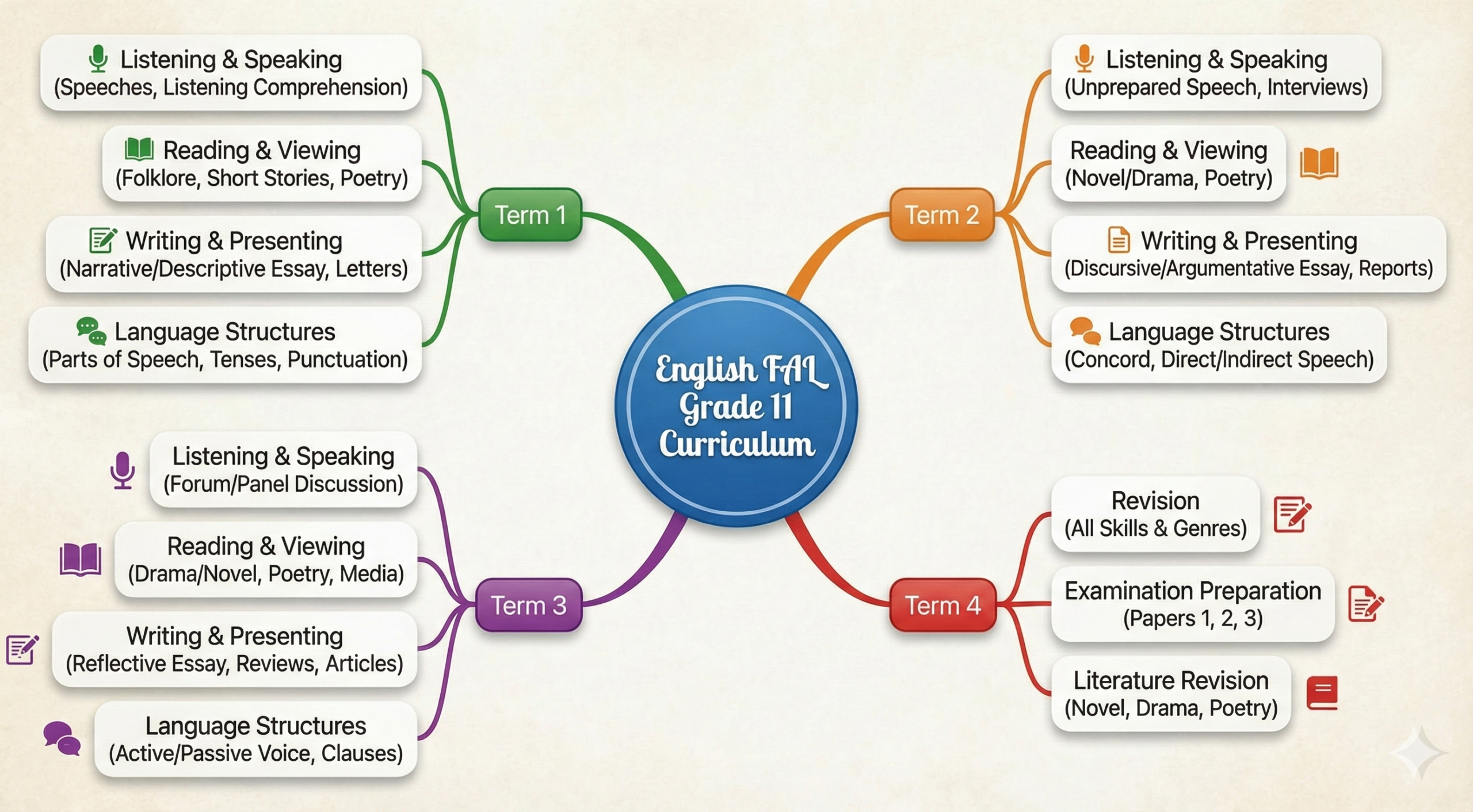
1. The 4 Main Skills
A. Listening & Speaking (Section 1)
This section is about communicating effectively and critically.
- Listening for Bias: You need to listen to a text and ask: “What does the speaker want me to think?” Look for emotive language (e.g., using “terrorist” instead of “freedom fighter”). Identifying the speaker’s hidden attitude is key to getting full marks.
- Speaking:
- Prepared Speech: Focus on your delivery. Eye contact and pacing are just as important as your content.
- Unprepared Speech: This terrifies most students. The secret weapon is the PREP method:
- Point: State your opinion immediately.
- Reason: Say why you think that.
- Example: Give a real-world example.
- Point: Conclude by restating your point.
B. Reading & Viewing (Section 2)
This prepares you for Papers 1 and 2.
- Literary Texts (Paper 2):
- Novel/Drama: Move beyond the plot. Grade 11 examiners want to know about Character Motivation. Why did the character make that choice? What is their fatal flaw?
- Poetry: You must be able to analyze sound devices.
- Assonance: Repetition of vowel sounds (“The rain in Spain”).
- Alliteration: Repetition of consonant sounds (“Dark deeds”).
- Tip: Don’t just find them; explain how they create a specific mood.
- Visual Literacy (Paper 1):
- Cartoons: Humor usually comes from Satire (mocking people/politics) or Irony. Ask yourself: “What is the cartoonist criticizing?”
- Advertising: Look for the “hidden message.” How do the font choice and layout manipulate the reader? Remember the AIDA principle (Attention, Interest, Desire, Action).

C. Writing & Presenting (Section 3)
In Grade 11, the length requirements increase, and the topics become more abstract.
- Essays (200-250 words):
- Discursive Essay: You must present both sides of an argument neutrally. (e.g., “The pros and cons of social media”).
- Argumentative Essay: Pick one side and fight for it. Be persuasive and strong.
- Reflective Essay: This is personal. Write about your feelings, growth, and internal thoughts.
- Transactional Texts:
- Formal Letters (120-150 words): Know the difference between a Letter of Complaint (firm but polite) and a Letter of Application (selling yourself).
- Instructions (80-100 words): Use the Imperative Mood. Start every sentence with a verb (e.g., “Mix the flour,” “Turn left”). Do not say “You must mix…”
D. Language Structures & Conventions (Section 4)
This is the “Grammar” in Paper 1.
- Active vs. Passive Voice: Crucial for formal writing.
- Active: “The chef cooked the meal.”
- Passive: “The meal was cooked by the chef.” (Focus moves to the object).
- Direct/Indirect Speech: This is a high-mark question. Remember the “Triangle of Change”:
- Pronouns: “I” \rightarrow “He/She.”
- Tense: Present \rightarrow Past; Past \rightarrow Past Perfect.
- Time Words: “Now” \rightarrow “then”; “Today” \rightarrow “that day.”
- Concord: Subject-Verb agreement. Remember: “The box of chocolates is heavy” (The subject is ‘box’, not ‘chocolates’).
2. Exam Breakdown
Paper 1: Language in Context (2 Hours – 80 Marks)
- Section A: Comprehension (30 marks)
- Section B: Summary (10 marks)
- Section C: Language Structures (40 marks)
Paper 2: Literature (2.5 Hours – 70 Marks)
- Section A: Novel OR Drama (Contextual + Essay questions)
- Section B: Short Stories (Contextual questions)
- Section C: Poetry (Contextual questions)
Paper 3: Writing (2.5 Hours – 100 Marks)
- Section A: Essay (50 marks)
- Section B: Longer Transactional Text (30 marks)
- Section C: Shorter Transactional Text (20 marks)
Decksh’s Top Tips for Distinction
Tip 1: The “Literature Essay” Structure
In Paper 2, you may have a choice to write a literature essay. Structure is everything here.
- Introduction: State your main argument (Thesis statement).
- Body Paragraphs (PEEL):
- Point: Make a claim.
- Evidence: Quote from the book.
- Explanation: Explain how the quote supports your point.
- Link: Connect back to the topic.
- Conclusion: Summarize your argument (do not introduce new ideas).
Tip 2: Comprehension Skills
- Own Words: When a question asks for “your own words,” never quote from the text. Read the sentence, look away, and rewrite the idea simply.
- Mark Allocation: If a question is worth 2 marks, you usually need to make one point and explain it, or make two distinct points. Don’t write a single word answer for a 2-mark question.
Tip 3: Editing Skills
In Paper 1 (Section C), you will be asked to correct errors in a text. Practice identifying:
- Spelling mistakes (commonly confused words like their/there).
- Punctuation errors (Apostrophes are a favorite—know the difference between possession (John’s) and contraction (it’s)).
- Tense inconsistency (Ensure the text stays in the Past or Present tense throughout).
Conclusion
Grade 11 is about refining your skills. Read as much as you can—newspapers, blogs, novels. The more you read, the better your vocabulary and sentence structure will become. Treat this year as your training ground for Matric, and you will excel.
Good luck!