
Many students think Grade 10 is a “rest year” after Grade 9. This is a dangerous mindset. Grade 10 is actually the foundation for your Matric final exams. The literature you study now introduces the themes you’ll see later, and the grammar rules (like Passive Voice and Reported Speech) must be mastered now, or you will struggle for the next three years.
This guide breaks down the Grade 10 English FAL curriculum, focusing on the specific skills you need to build right now to secure a distinction.
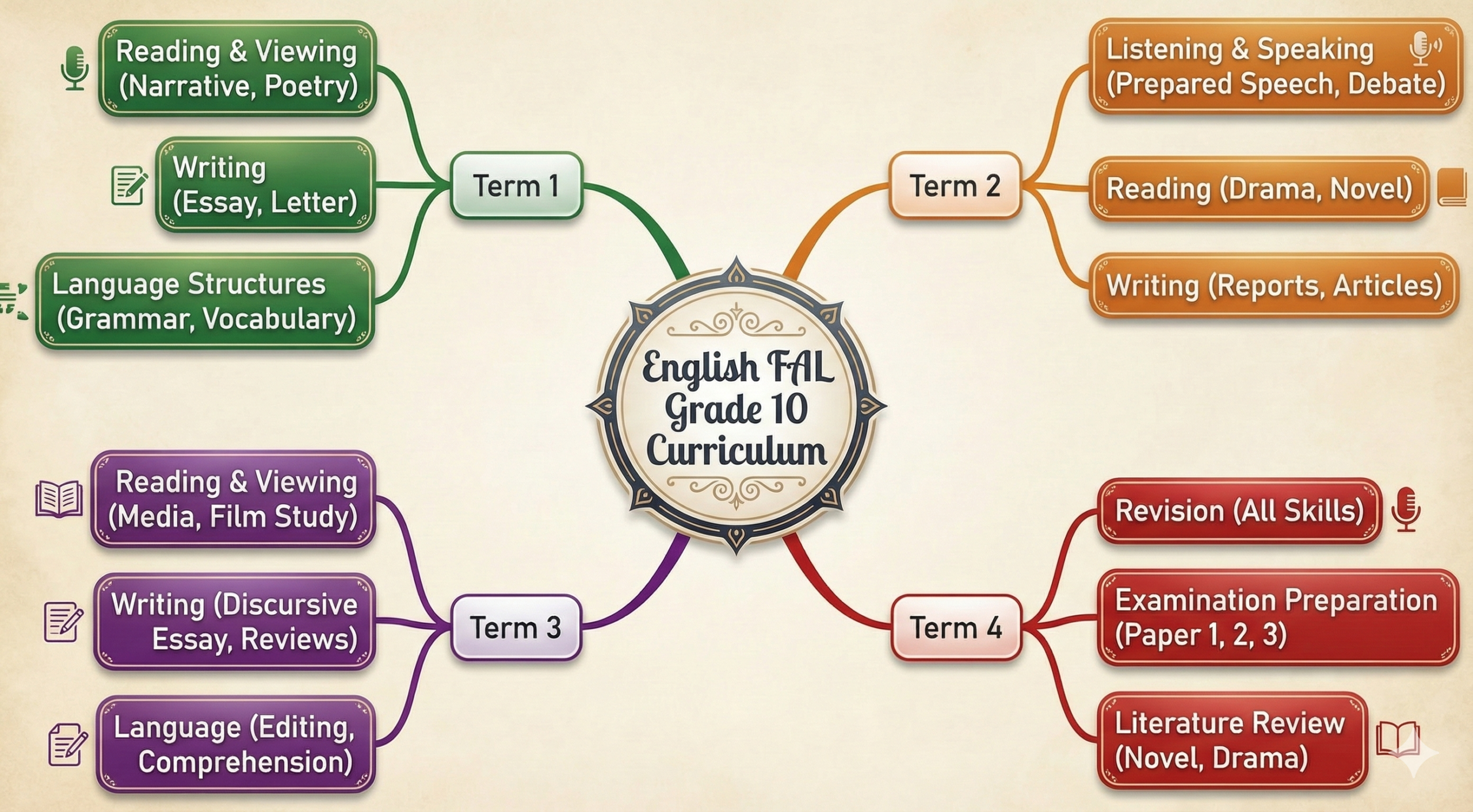
1. The 4 Main Skills
A. Listening & Speaking (Section 1)
This is often done as oral assessments throughout the year.
- Listening Comprehension: The trick here is note-taking. You usually hear the text twice.
- First Listen: Listen for the main idea. What is the story about?
- Second Listen: Listen for specific details (Dates, Names, Places). Write them down immediately.
- Prepared Speech: In Grade 10, confidence is key. Practice your eye contact. If you just read from your cards, you cannot get a distinction.
B. Reading & Viewing (Section 2)
This forms the core of Paper 1 (Comprehension) and Paper 2 (Literature).
- Comprehension: You need to move beyond just finding the answer in the text. You need to infer meaning.
- The “Own Words” Trap: If a question asks “Why is the boy sad? (Answer in your own words)”, and you quote the text, you get zero. You must read the sentence, understand it, and rewrite it using synonyms.
- Visual Literacy: This is new territory for many. You need to analyze advertisements and cartoons.
- Cartoons: Look for Body Language (are their fists clenched?) and Punctuation (are there bold exclamation marks?). These clues tell you the character’s emotion.
- Advertisements: Who is the Target Audience? If the ad uses slang and bright colors, the target is teenagers. If it uses formal language and statistics, it’s for adults/professionals.
C. Writing & Presenting (Section 3)
This is Paper 3. The length requirements increase in Grade 10.
- The Narrative Essay: This is telling a story.
- Distinction Tip: Show, Don’t Tell. Instead of writing “I was scared,” write “My knees knocked together and my palms began to sweat.” This paints a picture for the marker.
- Transactional Texts:
- Formal Letters: You must master the format now. Your address on the right, recipient on the left, formal salutation (“Dear Sir/Madam”).
- Diary Entries: These must be personal and emotional. Start with “Dear Diary” and write in the First Person (“I”).
D. Language Structures & Conventions (Section 4)
This is the “Grammar” section in Paper 1. It is mathematical—there is always a right and wrong answer.
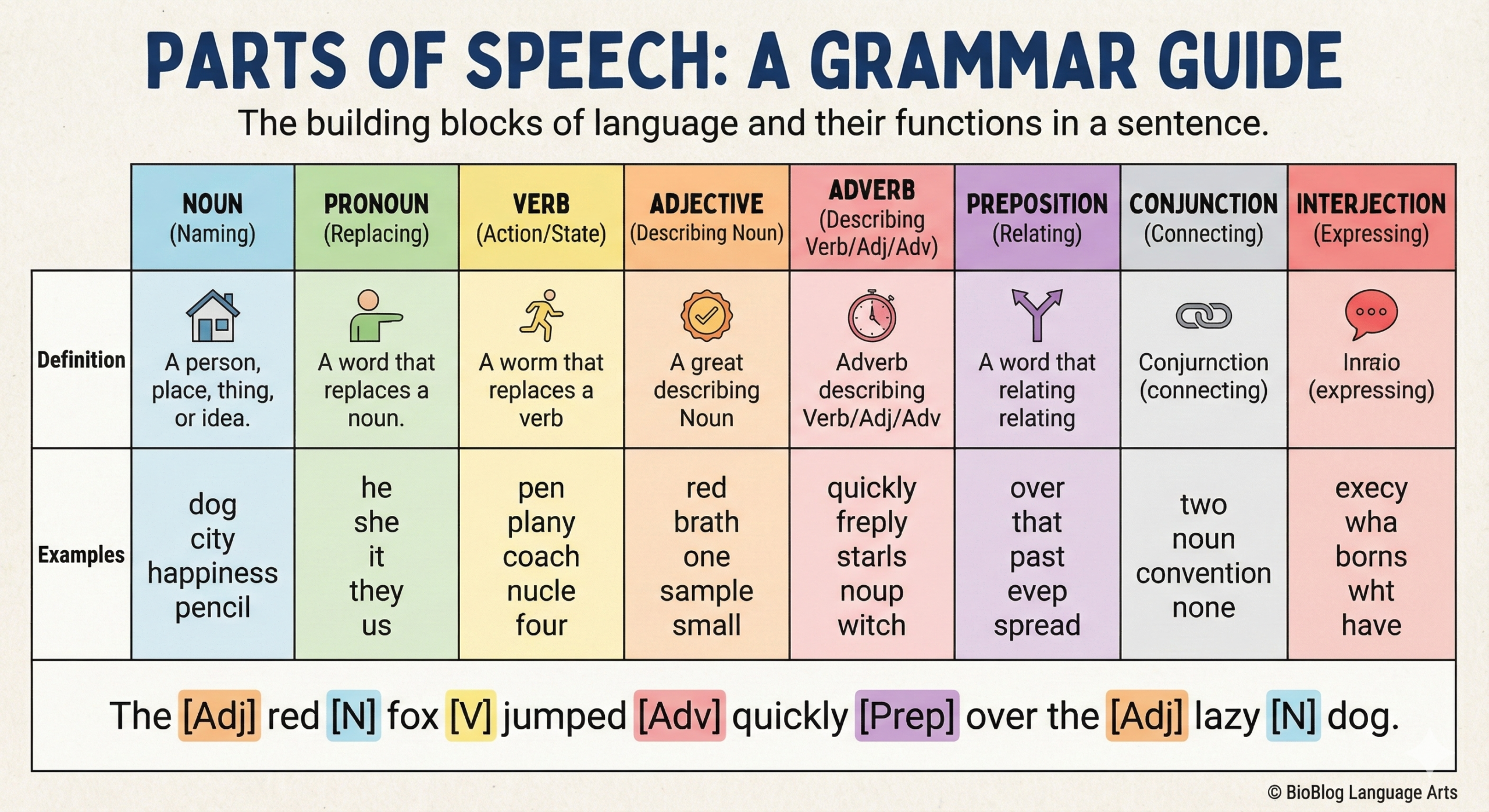
- Parts of Speech: You must know the difference between a specific noun (Proper Noun) and a general noun (Common Noun). Adjectives describe nouns; Adverbs describe verbs.
- Tenses: Grade 10 focuses heavily on the Past Tense. Be careful with irregular verbs (e.g., “teach” \rightarrow “taught,” not “teached”).
- Concord: This is the most common error. The subject and verb must agree.
- Wrong: “The list of names are long.”
- Right: “The list of names is long.” (The subject is “list” [singular], not “names”).
2. Exam Breakdown
Paper 1: Language in Context (2 Hours – 80 Marks)
- Section A: Comprehension (30 marks)
- Section B: Summary (10 marks)
- Section C: Language Structures (40 marks)
Paper 2: Literature (2 Hours – 70 Marks)
- Section A: Novel (e.g., Finders Keepers) OR Drama
- Section B: Short Stories
- Section C: Poetry (Seen and Unseen poems)
Paper 3: Writing (2 Hours – 100 Marks)
- Section A: Essay (50 marks)
- Section B: Longer Transactional Text (30 marks)
- Section C: Shorter Transactional Text (20 marks)
Decksh’s Top Tips for Distinction
Tip 1: Master the “Summary”
The summary question in Paper 1 is the easiest 10 marks you will ever get, but you must follow the rules.
- Format: Number your points 1 to 7.
- Word Count: Do not go over 70 words. The marker stops reading at 70.
- The Secret: Cross out examples, adjectives, and repetitions in the original text. You only want the main facts.
Tip 2: Learn Your Literary Devices
In Paper 2 (Poetry), you cannot just say “The poet uses a metaphor.” You must explain why.
- Formula: “The poet uses a metaphor comparing [A] to [B] to emphasize that…”
- Example: “The metaphor ‘her eyes were fire’ emphasizes her intense anger.”
Tip 3: Fix Your Spelling
In Grade 10, spelling starts to count more.
- Common mistakes: because (not “coz”), accommodation (double c, double m), definitely (not “definately”).
- If you spell a word wrong in the Language paper, you might lose the mark even if the answer is technically correct.
Conclusion
Grade 10 English FAL is about building your toolkit. If you master the formats of the essays and the rules of grammar now, you are setting yourself up for an easy ride in Matric. Read as much as you can to improve your vocabulary naturally.
Good luck!