
Grade 12 Mathematics is arguably the most important exam of your school career. It opens doors to Engineering, Medicine, and Commerce. But here is the secret: Maths is not about being a “genius”; it is about pattern recognition.
The curriculum is split into two papers, and they test completely different parts of your brain. Paper 1 is about Algebra and flow (Calculus, Sequences), while Paper 2 is about Visual logic (Geometry, Trig).
Here is my breakdown of the “Major Weight” topics you need to master to secure your distinction.
Paper 1: Algebra, Calculus & Functions (150 Marks)
This paper is usually more predictable than Paper 2. If you practice past papers, you will see the same questions appearing with different numbers.
A. Functions & Graphs (±35 Marks)
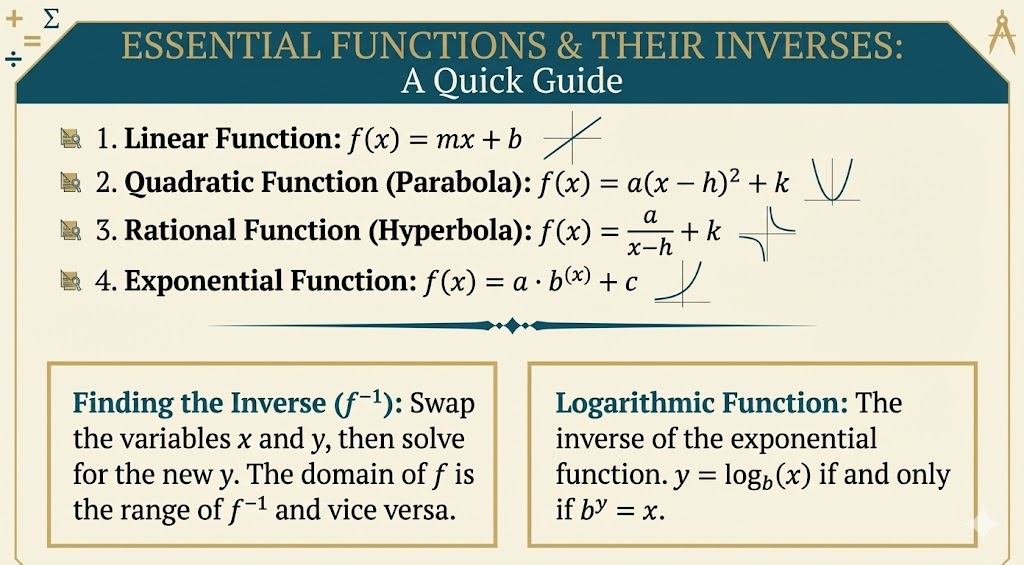
You cannot get a distinction without mastering graphs. You need to know the properties of the Straight Line, Parabola, Hyperbola, and Exponential graphs inside out.
- The Inverse Trap: Examiners love asking for the inverse (f^{-1}) of a function. Remember the golden rule: Swap x and y, then make y the subject.
- The Logarithmic Function: This scares many students, but it is simply the inverse of the Exponential graph. If you can draw y = 2^x, you can draw y = \log_2 x by reflecting it across the line y = x.
B. Calculus (±35 Marks)
Calculus is a new topic in Grade 12, but it carries a huge weight.
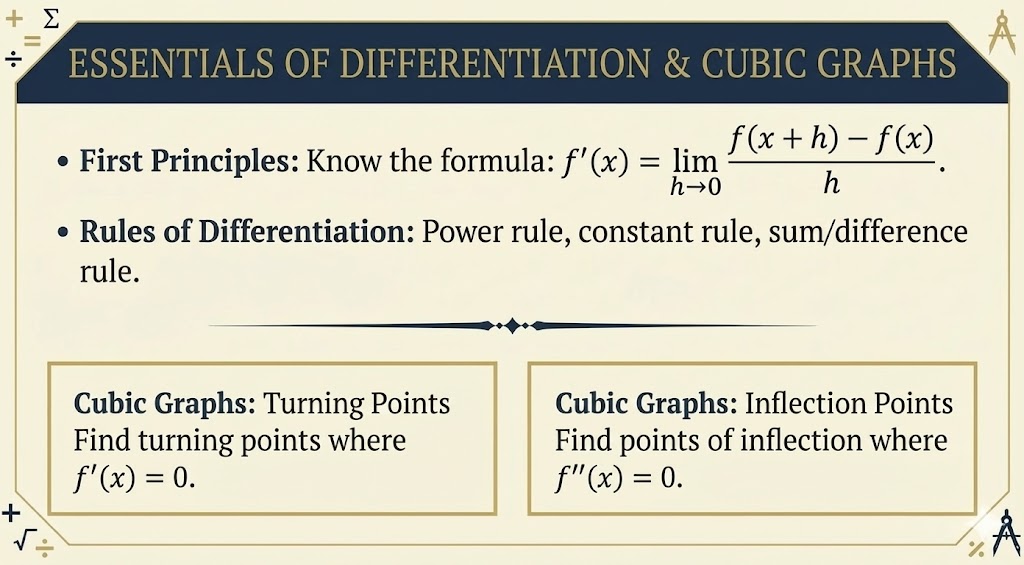
- First Principles: You will likely get one question asking you to derive the derivative using “First Principles” (the long formula). Learn this method, but use the “Power Rule” to check your answer immediately.
- Cubic Graphs: These are “free marks.” You follow a set recipe: Find the x-intercepts, find the turning points (where f'(x) = 0), and find the point of inflection (where f''(x) = 0).
- Optimization: This is the practical application. You will be given a real-world problem (like minimizing the cost of a can or maximizing the volume of a box). The trick? Create an equation, derive it, and set it to zero.
Paper 2: Geometry & Trigonometry (150 Marks)
This paper requires you to “see” the answer. It relies heavily on theorems from Grade 11.
C. Euclidean Geometry (±50 Marks)
This is often the section students fear most. It involves Circle Geometry and the new Grade 12 topics: Proportionality and Similarity.
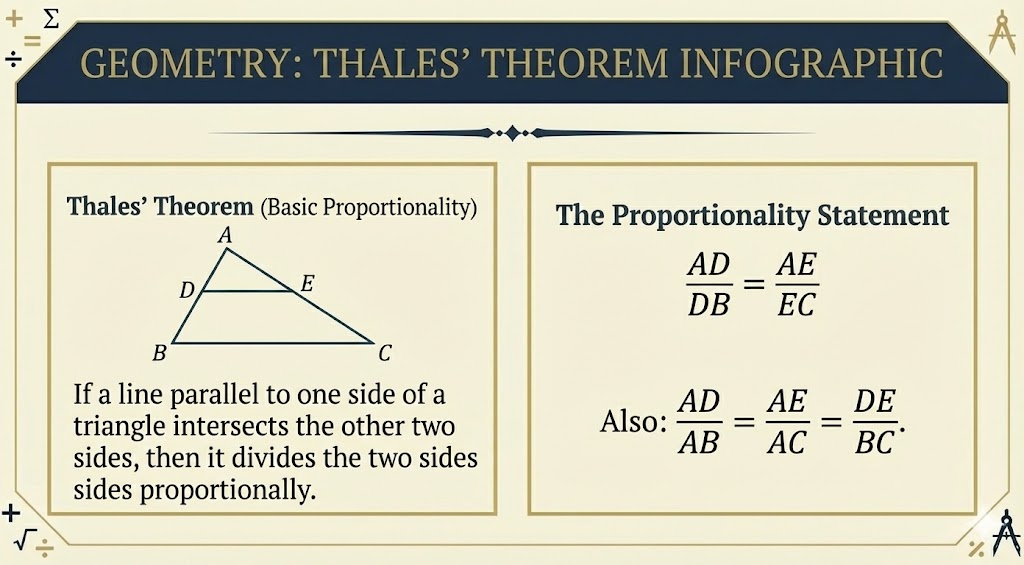
- Ratio & Proportion: Look for the “Proportionality Theorem.” If a line is drawn parallel to one side of a triangle, it divides the other two sides proportionally.
- Similarity (AAA): You rarely need to prove triangles are congruent in Grade 12; you usually need to prove they are similar (equiangular). Once you prove similarity, you can set up the ratio equation:
\frac{DE}{AB} = \frac{EF}{BC}
D. Trigonometry (±40 Marks)
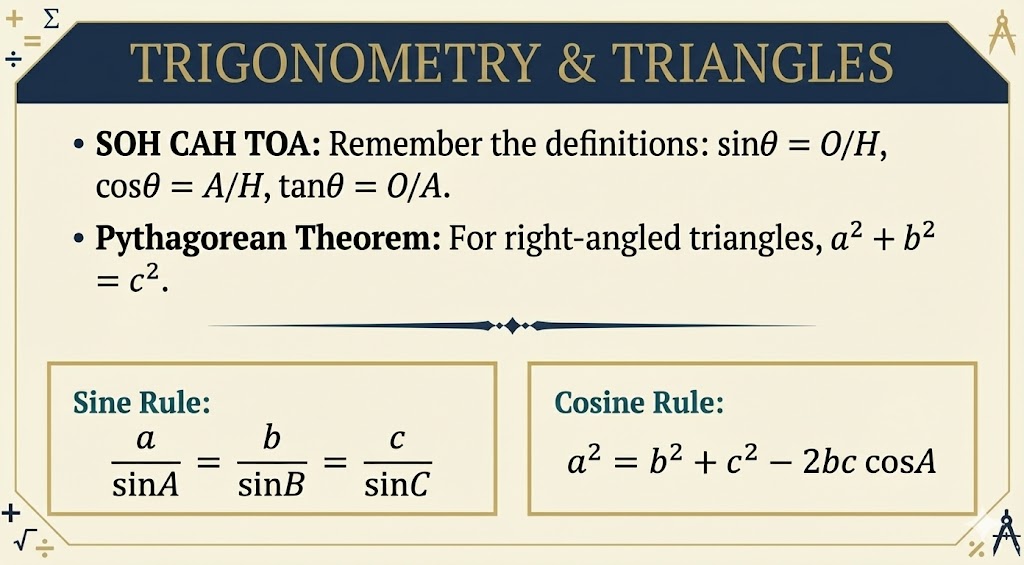
- Compound & Double Angles: You will be given an identity sheet, but you need to know when to use it. If you see \sin(2x), immediately expand it to 2\sin x \cos x.
- 2D & 3D Problems: These are the visual puzzles. You will need to use the Sine Rule, Cosine Rule, and Area Rule to solve complex triangles. Tip: In 3D problems, always look for the “common side” that connects the vertical triangle to the horizontal triangle.
Decksh’s Top 3 Tips for a Distinction
Tip 1: Master the “Information Sheet”
The exam paper includes a formula sheet, but relying on it blindly is a mistake.
- Know what is MISSING: Not every formula is on the sheet. For example, some Financial Maths formulas (like specific variations of Present Value) might not be there.
- Don’t Memorize, Apply: Do not waste brain space memorizing the Quadratic Formula. Instead, spend your time learning how to type it into your calculator correctly without making bracket errors.
Tip 2: Euclidean Geometry “Acceptable Reasons”
In Geometry proofs, your logic is only as good as your reason.
- The Rule: You cannot just write “angles in a circle.” You must use the standard, acceptable abbreviations listed in the Examination Guidelines.
- Examples: Use “tan chord theorem” or “opp angles cyclic quad.” If you invent your own abbreviations, the marker cannot give you the mark.
Tip 3: Calculator Skills (Statistics)
In the Statistics section (Paper 2), time is your enemy.
- Stat Mode: Learn to use your calculator’s “Stat Mode” (usually Mode 2 or 3 depending on your model).
- Why? You can punch in the data points, and the calculator will instantly give you the Equation of the Regression Line (y = A + Bx) and the Correlation Coefficient (r). Doing this manually takes 20 minutes; the calculator does it in 2 minutes.
Conclusion
Grade 12 Maths is a marathon, not a sprint.
- Paper 1: Focus on Calculus and Functions first—they make up nearly half the paper and are very predictable.
- Paper 2: Practice Euclidean Geometry every single day. You need to train your eye to see the “bow-ties” and “cyclic quads” hidden in the diagrams.
Good luck! You’ve got this.