
Many students treat Grade 10 as a “rest year” after Grade 9. This is the biggest mistake you can make. Grade 10 is the foundation for Matric. If you have gaps in your understanding of Factorisation or Euclidean Geometry now, you will struggle in Grade 11 and 12.
This guide breaks down the massive jump in difficulty from Grade 9 to Grade 10 and shows you exactly how to master the new curriculum.
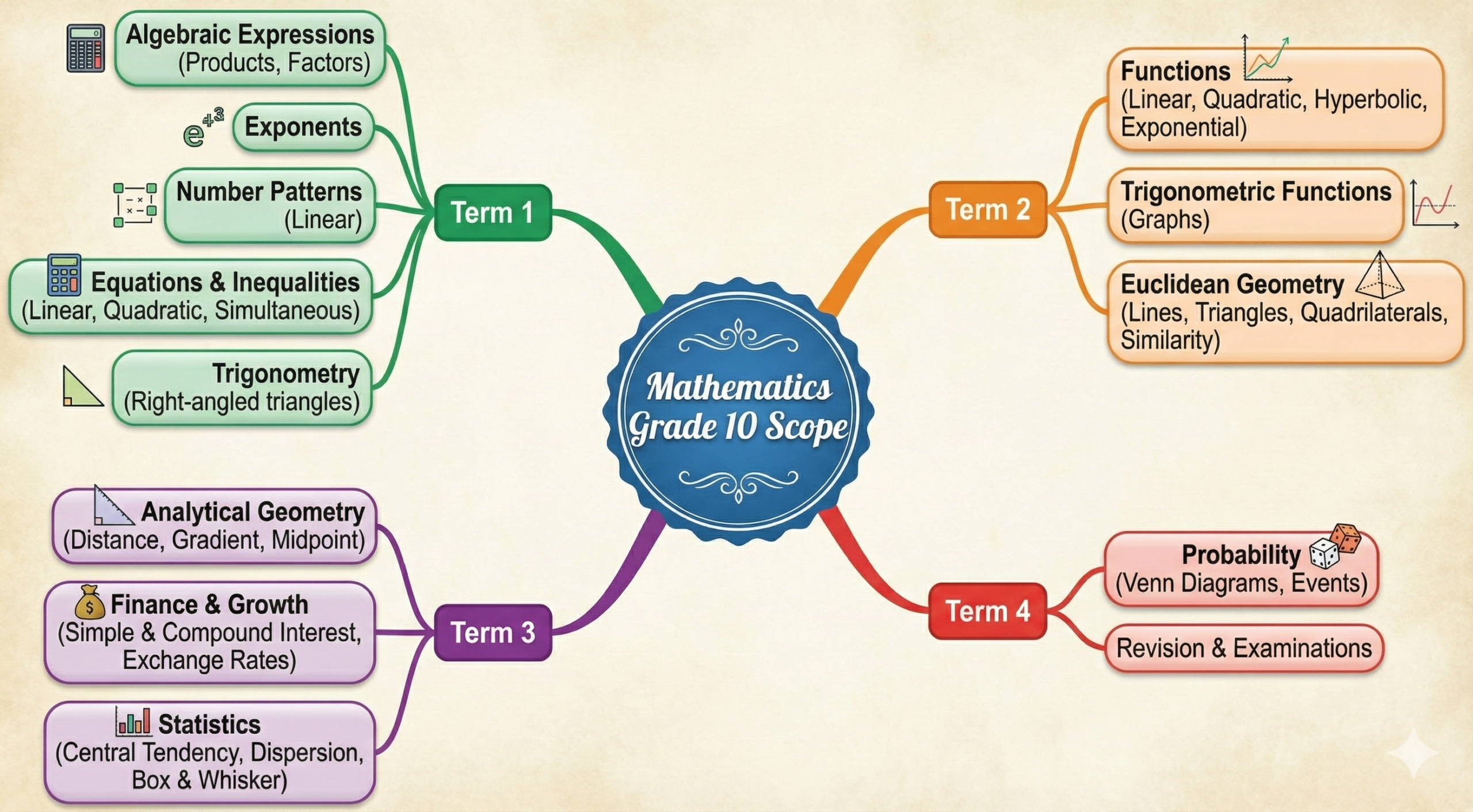
Paper 1: Algebra, Equations & Functions (100 Marks)
Paper 1 is about technique. You need to be fast and accurate.
1. Algebraic Expressions & Equations (±30 Marks)
This is the toolbox for the rest of the year.
- The Number System: You must know the difference between Non-Real (square root of a negative number) and Undefined (dividing by zero). This is often Question 1.1.
- Factorisation: This is the most important skill in high school Maths. You need to master the “Big 4”:
- Common Factor: Always look for this first.
- Difference of Two Squares: x^2 - y^2 = (x-y)(x+y). Watch out: x^2 + y^2 cannot be factorised!
- Trinomials: Finding factors of the last term that add up to the middle term.
- Grouping: When you see 4 terms, group them in pairs.
2. Number Patterns (±15 Marks)
- Linear Patterns: In Grade 10, we focus on patterns with a constant difference.
- The Formula: Memorize T_n = an + q (or dn + c).
- a (or d) is the constant difference.
- q (or c) is what term 0 would be.
3. Functions & Graphs (±30 Marks)
You move from just plotting points to understanding the “Mother Graphs.”
- The “Big 3”:
- Parabola (y = ax^2 + q)
- Hyperbola (y = \frac{a}{x} + q)
- Exponential (y = a \cdot b^x + q)
- The “q” Effect: You need to understand that “q” simply shifts the graph up or down. If q is positive, the graph moves up.
- Domain & Range: This confuses many students.
- Domain: What x-values are allowed? (e.g., in a Hyperbola, x cannot be 0).
- Range: What y-values are possible?
Paper 2: Geometry, Trigonometry & Stats (100 Marks)
Paper 2 tests your visual logic. It requires you to “see” the answer.
1. Euclidean Geometry (±30 Marks)
This is the biggest shock for Grade 10s. You can no longer just say “because it looks equal.” You need a Statement and a Reason.
- Triangles: Focus on Congruency (SSS, SAS, AAS, RHS) and Similarity (AAA).
- Quadrilaterals: Learn the properties of a Parallelogram, Rhombus, Rectangle, Square, and Kite. If you need to prove a shape is a Parallelogram, you need to prove opposite sides are parallel.
- The Midpoint Theorem: This is the big new theorem for Grade 10.
Definition: The line joining the midpoints of two sides of a triangle is parallel to the third side and equal to half the length of the third side.
2. Trigonometry (±40 Marks)
This is a brand new topic introduced in Grade 10.
- SOH CAH TOA: Memorize the ratios:
- \sin\theta = \frac{\text{Opposite}}{\text{Hypotenuse}}
- \cos\theta = \frac{\text{Adjacent}}{\text{Hypotenuse}}
- \tan\theta = \frac{\text{Opposite}}{\text{Adjacent}}
- Calculator Settings: Make sure your calculator has a tiny “D” at the top for Degrees. If it shows “R” (Radians), all your answers will be wrong.
- 2D Problems: You will use these ratios to calculate the height of buildings or the distance of ships. Always start by identifying the Right-Angled Triangle.
3. Analytical Geometry (±15 Marks)
This combines Algebra with Geometry. It relies heavily on formulas.
- Distance Formula: Length of a line.
- Midpoint Formula: Finding the middle of a line.
- Gradient (m): The slope of the line. Remember: Parallel lines have equal gradients; Perpendicular lines have gradients that multiply to -1.
Decksh’s Top 3 Tips for a Distinction
Tip 1: Master the “Statement & Reason” Layout
In Geometry, you get zero marks for the correct answer if you don’t provide the correct reason.
- Bad Answer: x = 50 (angles on line).
- Good Answer: x + 130^\circ = 180^\circ (∠s on a str line). \therefore x = 50^\circ.
- You must study the “Acceptable Reasons” list in the exam guidelines.
Tip 2: Don’t Ignore Statistics
Statistics (Mean, Median, Mode) is often taught quickly at the end of the year, but it is usually “free marks” in the exam.
- Grouped Data: Learn how to calculate the Estimated Mean using the midpoint of the intervals.
- Box and Whisker: Know how to draw this using the “Five Number Summary” (Min, Q1, Median, Q3, Max).
Tip 3: Practice “Simultaneous Equations”
This pops up everywhere—in Algebra (where lines intersect) and in Word Problems.
- The Method: Make one variable the “subject” of the simpler equation (e.g., x = 3 - 2y), then substitute it into the complex equation. This skill is used right up to Grade 12.
Conclusion
Grade 10 Maths is about building a strong foundation. Don’t just memorize methods; try to understand why they work. If you master Factorisation and Triangles this year, you are setting yourself up for success in Matric.
Good luck with your exams!