
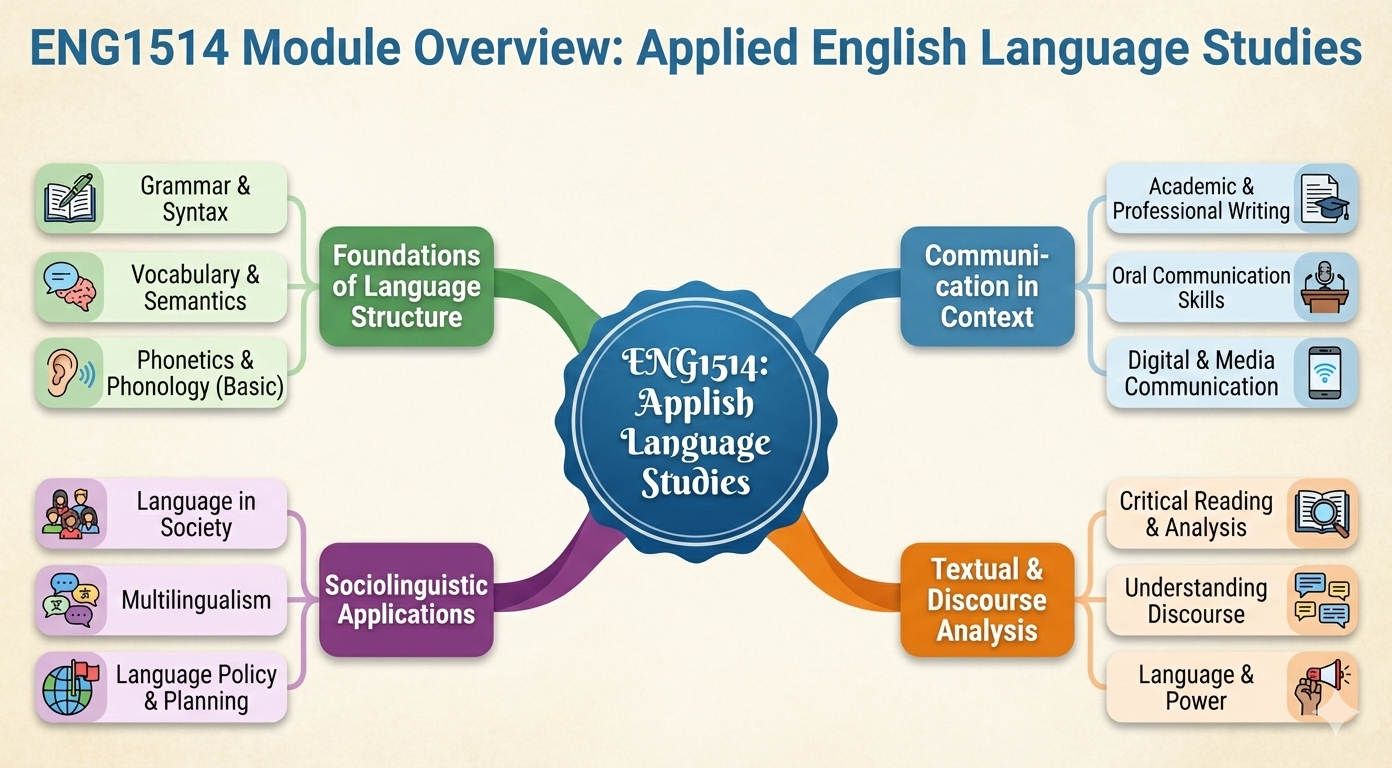
ENG1514 is the “Mechanics of English” module. It is designed for future Foundation Phase teachers (Grade R-3). You aren’t just learning grammar for yourself; you are learning the metalanguage (words used to describe language) so you can explain it to a 7-year-old.
The exam doesn’t just ask “What is a noun?”; it asks “How would you teach a noun to a Grade 1 class using the Inductive method?” If you can’t make that jump from theory to practice, you will struggle.
This guide breaks down the three critical sections of the curriculum.
1. Language Acquisition Theories (The “Big 4”)
You cannot pass this module without memorizing these four theorists. You need to know what they believed and, more importantly, how it looks in a classroom.
The Behaviourist View (B.F. Skinner)
-
The Theory: Children learn language through imitation and reinforcement. It’s all about “stimulus and response.”
-
In the Classroom: This is rote learning. “Repeat after me: C-A-T spells Cat.” If the child gets it right, you give them a sticker (Positive Reinforcement).
The Nativist View (Noam Chomsky)
-
The Theory: Humans are born with a Language Acquisition Device (LAD) in their brains. We are “hardwired” for grammar. We don’t just copy; we create new sentences we’ve never heard before.
-
In the Classroom: Allowing children to experiment with language and make mistakes (e.g., “I goed to the shop”) because it shows their internal grammar engine is working.
The Cognitive View (Jean Piaget)
-
The Theory: Language development follows cognitive development. A child cannot talk about the past until they understand the concept of time.
-
In the Classroom: Using concrete objects (blocks, toys) to match the child’s developmental stage.
The Social Interactionist View (Lev Vygotsky)
-
The Theory: Language is social. We learn by talking to people “smarter” than us.
-
Key Concept: The Zone of Proximal Development (ZPD). This is the gap between what a child can do alone and what they can do with help.
-
In the Classroom: Group work and “Scaffolding” (the teacher helps a little bit, then steps back).
2. Grammar and Structure (The Toolkit)
You need to know your Parts of Speech. If you can’t identify an Adverb, you can’t teach it.
-
Content Words: Nouns, Verbs, Adjectives, Adverbs. (These carry the meaning: “Big Dog Runs Fast”).
-
Function Words: Prepositions, Pronouns, Conjunctions. (The glue that holds the sentence together: “The… on… the…”).
-
Sentence Structure:
-
Simple: One verb (“The dog barked”).
-
Compound: Two simple sentences joined by a conjunction (“The dog barked and the cat ran”).
-
Complex: One main idea and one supporting idea (“The dog barked because he was hungry”).
-
3. Approaches to Teaching (The “How”)
This is a guaranteed exam question. You must know the difference between Deductive and Inductive teaching.
Deductive Teaching (Rule-Driven)
-
The Method: The teacher explains the rule first, then gives examples.
-
Example: “Today we are learning the Past Tense. You add ‘-ed’ to the verb. Now do this worksheet.”
-
Pros/Cons: It is fast, but boring for young kids.
Inductive Teaching (Discovery-Driven)
-
The Method: The teacher gives examples first, and the learners figure out the rule.
-
Example: “Look at these sentences: ‘I walked’, ‘She played’, ‘He kicked’. What do you notice about the ending of the action words?”
-
Pros/Cons: It takes longer, but the children understand it better because they “discovered” it.
Decksh’s Top 3 Tips for a Distinction
Tip 1: The South African Context
ENG1514 is not taught in a vacuum. You must mention Multilingualism.
-
Code-Switching: This is not “bad English”; it is a valuable teaching tool. If a child doesn’t understand the English word “Table,” you can use the isiZulu word “iTafile” to help them bridge the gap.
-
EFAL: Remember that for most of your learners, English will be a First Additional Language (FAL), not a home language.
Tip 2: Scenario Application
Don’t just memorize definitions. The exam will give you a scenario:
“Mrs. X reads a story and asks learners to guess the meaning of new words from the pictures.”
-
Question: Is this incidental or explicit vocabulary teaching?
-
Answer: It is Incidental (learning while doing something else), and she is using context clues.
Tip 3: Master the “Concord” Rule
Concord (Subject-Verb Agreement) is the most common error in student writing.
-
Singular Subject: “The boy eats.” (Verb gets an ‘s’).
-
Plural Subject: “The boys eat.” (Verb has no ‘s’).
-
If you make concord errors in your exam essay about teaching grammar, you will lose credibility and marks.
Conclusion
ENG1514 prepares you to be the first English teacher a child ever has. That is a huge responsibility. If you understand the difference between Skinner’s imitation and Chomsky’s creativity, and you know how to teach grammar Inductively, you will pass with distinction.
Good luck!