
Welcome to ENG1503. If you treat this module with respect, it will boost your GPA. If you treat it as “just an English subject,” you will fail.
The core lesson of this module is simple: Stop writing like you talk. In high school, you were rewarded for flowery, emotional creative writing. In university, that will get you a mark of 30%. University writing is cold, objective, and evidence-based.
This guide breaks down the four pillars of Academic Literacy you need to master.
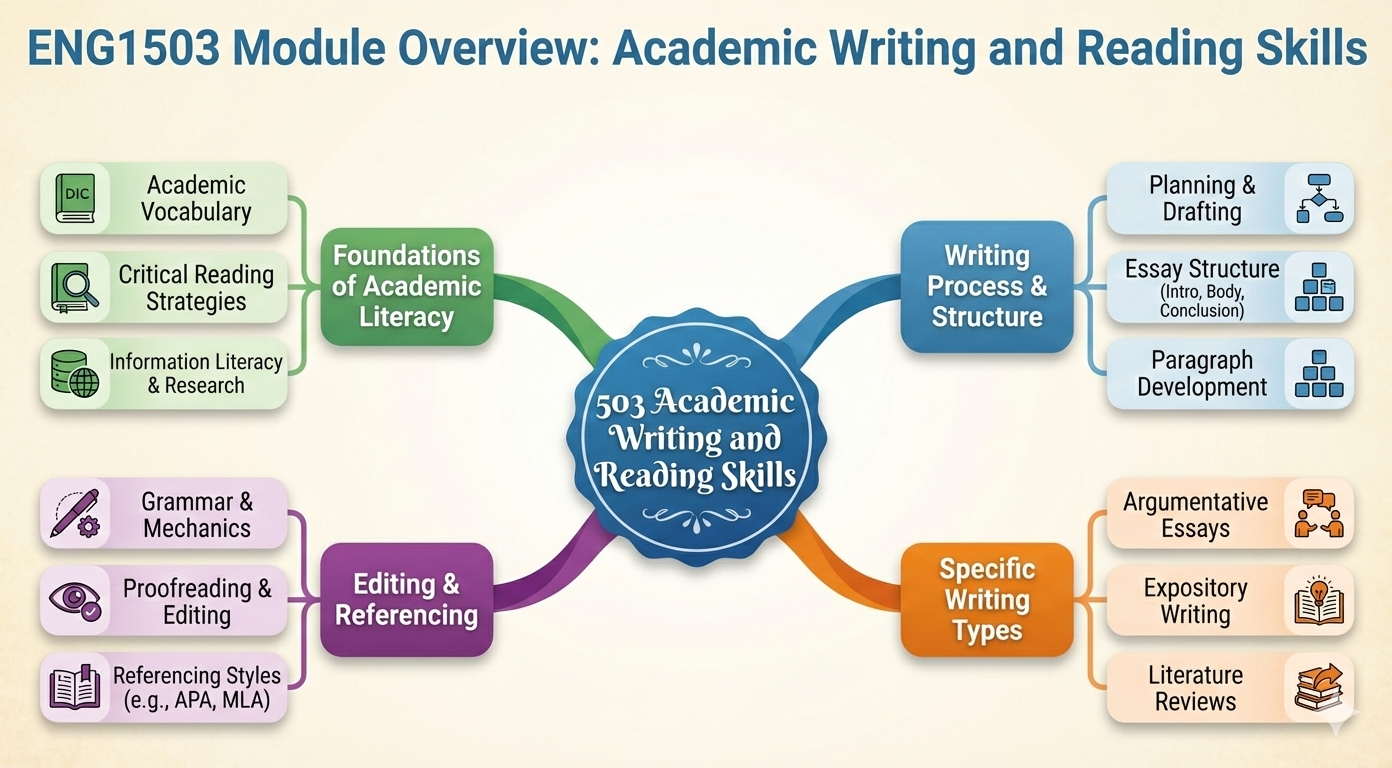
1. Academic Writing Style (The Tone)
This is the biggest adjustment. You need to strip your writing of emotion.
-
Objective vs. Subjective:
-
Bad (Subjective): “I think that pollution is really bad and we should stop it.”
-
Good (Objective): “Pollution has detrimental effects on the ecosystem and requires immediate intervention.”
-
-
The “I” Ban: Unless the assignment specifically asks for a “Reflective Essay,” never use the word “I” or “My”. Instead of “In my essay, I will discuss…”, write “This essay will discuss…”
-
Formal Vocabulary: Stop using “big” words to sound smart. Use precise words.
-
Don’t say “get”; say “obtain.”
-
Don’t say “bad”; say “negative” or “adverse.”
-
2. The Writing Process (The Method)
UNISA doesn’t just mark the final essay; they mark the process. You need to show evidence of these stages:
-
Pre-writing (Brainstorming): This is your mind map. You must be able to group related ideas together.
-
Drafting: Getting the ideas onto paper. Focus on the structure (Introduction, Body, Conclusion).
-
Revising: This is looking at the “Big Picture.” Does paragraph 2 flow into paragraph 3? (See “Cohesion” below).
-
Editing: This is the microscope work. Checking for spelling, commas, and capital letters.
-
Exam Tip: Questions often ask, “Which stage of the writing process involves checking for grammar?” The answer is Editing, not Revising.
-
3. Reading Strategies (Skimming vs. Scanning)
You will be given a text and asked how you would read it. You need to know the difference.
-
Skimming (The Gist):
-
Goal: To get the general idea.
-
Method: Read the Title, the Introduction, the first sentence of every paragraph, and the Conclusion.
-
When to use: Deciding if a book is relevant for your assignment.
-
-
Scanning (The Detail):
-
Goal: To find a specific fact.
-
Method: You don’t read every word. Your eyes move rapidly looking for a keyword (e.g., a date like “1994” or a name like “Mandela”).
-
When to use: Looking for a phone number in a directory or an answer in an exam text.
-
4. Cohesion and Coherence
These two words sound the same, but they mean different things. You need to know the difference for the multiple-choice section.
-
Coherence: Does the essay make sense as a whole? Are the arguments logical?
-
Cohesion: Do the sentences “stick” together? This is achieved using Linking Words.
-
Addition: Furthermore, Moreover, Additionally.
-
Contrast: However, On the other hand, Conversely.
-
Result: Therefore, Consequently, Thus.
-
Tutor Tip: If you start a sentence with “And” or “But,” you lose marks. Use “In addition” or “However” instead.
-
Decksh’s Top 3 Tips for a Distinction
Tip 1: The “Topic Sentence” Rule
Every single paragraph you write must start with a Topic Sentence.
-
This sentence tells the reader exactly what the paragraph is about.
-
Rule: If your paragraph discusses “Climate Change,” do not suddenly start talking about “Plastic Pollution” in the middle of it. Start a new paragraph.
Tip 2: Critical Reading
ENG1503 tests your ability to spot Bias.
-
When reading a text, ask: “Is this a Fact or an Opinion?”
-
Fact: “Water boils at 100 degrees.” (Can be proven).
-
Opinion: “Water is the best drink.” (Cannot be proven).
-
-
Look for “Emotive Language” (words like horrific, amazing, disgusting). These indicate the writer is biased.
Tip 3: Referencing is Non-Negotiable
Plagiarism is an automatic 0%. You must master the Harvard Method.
-
In-text: (Smith, 2020: 45). Note the colon and the spacing.
-
Bibliography: Smith, J. 2020. The Art of Writing. Pretoria: UNISA Press.
-
If you forget the date or the publisher, you lose technical marks.
Conclusion
ENG1503 is the toolkit for your degree. The skills you learn here—how to structure an argument, how to reference, and how to read critically—are used in every other module you will take. Master the Formal Register, and the rest is easy.
Good luck!