
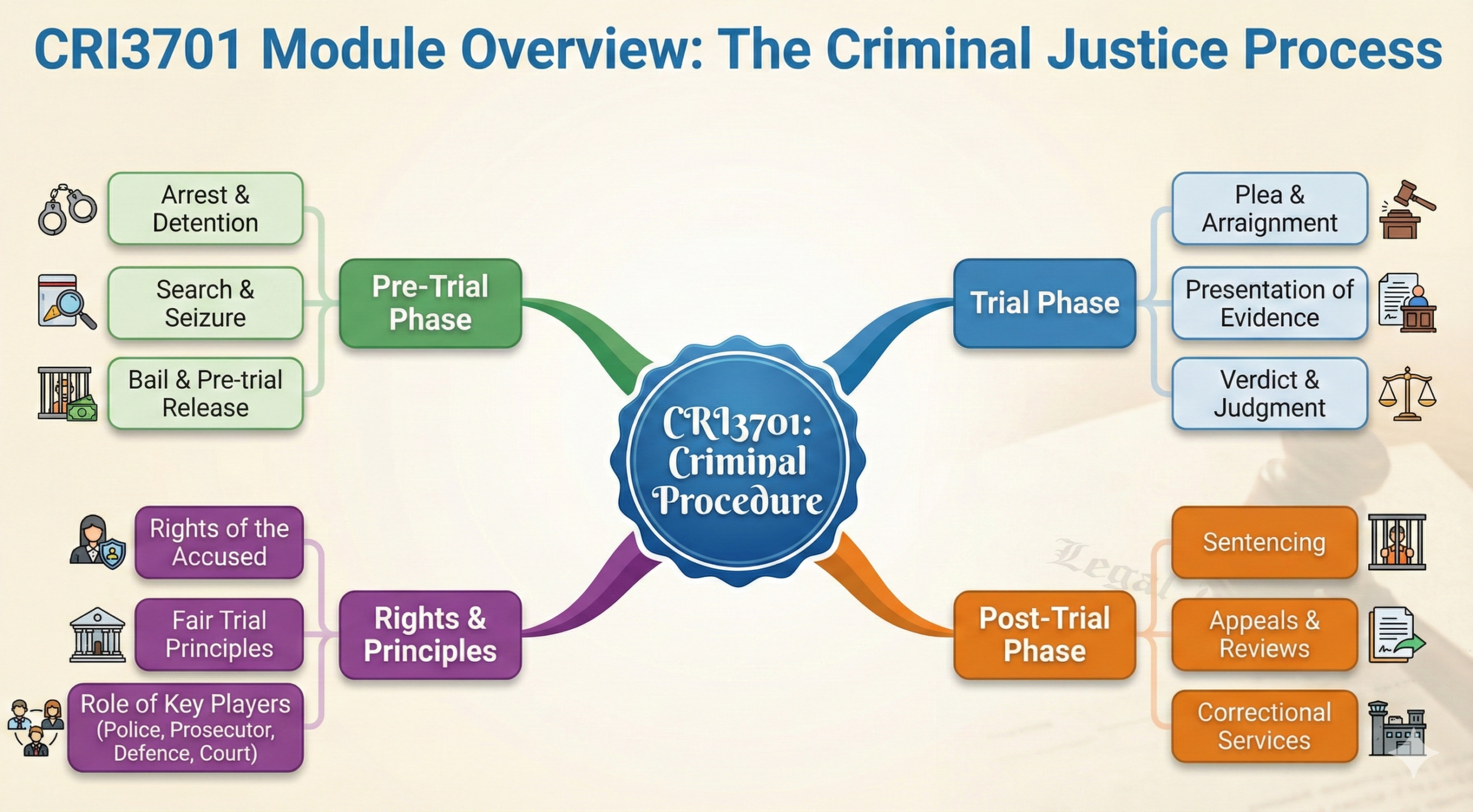
CRI3701 is the module where you learn how to handle the most unpredictable element in a courtroom: The Human Witness.
Many students fail this module because they confuse the rules of who can speak (Competence) with who must speak (Compellability). They also struggle with the strict rules of Cross-Examination. To get a distinction, you need to master the Criminal Procedure Act (CPA) sections that govern the “Life Cycle of a Witness.”
This guide breaks down the curriculum into the practical skills you need for the exam.
1. Competence vs. Compellability (The Foundation)
This is the first concept you must master. If you mix these up, you will fail the first question.
Competence (Can they testify?)
-
The General Rule (Section 192 CPA): Everyone is competent to testify unless the law says otherwise.
-
The Exceptions:
-
Children: A child is competent if they understand what it means to tell the truth. They do not need to understand the oath; they just need to understand the difference between truth and lies.
-
Mentally Ill Persons (Section 194): They are incompetent only if their illness prevents them from communicating or understanding the truth at the time of the trial.
-
Compellability (Must they testify?)
-
The General Rule: If you are competent, you are usually compellable. You have no choice; if subpoenaed, you must speak.
-
The “Spouse” Trap (Section 198): This is an exam favorite.
-
A spouse is always competent.
-
A spouse is compellable for the Defence (to save their partner).
-
A spouse is NOT compellable for the State (to jail their partner), unless the crime falls under specific exceptions (like domestic violence or crimes against children).
-
2. The Stages of Trial (The Workflow)
You need to visualize the witness in the box. The exam will ask you what is allowed in each stage.
Stage 1: Examination-in-Chief
-
Goal: To get your witness to tell their story.
-
The Golden Rule: You are NOT allowed to ask Leading Questions (questions that suggest the answer, e.g., “Did you see him holding the red knife?”). You must ask open questions (“What did you see him holding?”).
Stage 2: Cross-Examination
-
Goal: To destroy the credibility of the opponent’s witness.
-
The Rules:
-
You CAN ask Leading Questions.
-
You MUST “put your version” to the witness. If you don’t challenge a statement they make, the court assumes you agree with it. This is a fatal error in court.
-
Stage 3: Re-Examination
-
Goal: To repair the damage done during cross-examination.
-
Limit: You can only ask about things that were raised during cross-examination. You cannot introduce brand new evidence here just because you forgot it earlier.
3. Refreshing Memory
Witnesses forget things. The law allows them to look at their notes, but strict rules apply.
-
In the Box (During Trial):
-
The notes must have been made contemporaneously (at the time of the incident or shortly after).
-
The witness must have made the notes personally (or checked them while the memory was fresh).
-
-
Before Trial: A witness can read anything they want to refresh their memory before they enter the court. However, the defence is entitled to see those notes if they are used.
4. Impeaching Credibility (Section 190)
What do you do if your own witness lies in court?
-
You cannot just cross-examine your own witness. You must apply to the court to have them declared a “Hostile Witness.”
-
Once the judge agrees they are hostile, you are allowed to cross-examine them as if they were a witness for the other side.
Decksh’s Top 3 Tips for a Distinction
Tip 1: Memorize Section 196 (The Accused)
The accused is a special witness.
-
They are Competent to testify in their own defence.
-
They are Not Compellable (The State cannot force them into the box because of the Right to Silence).
-
But: If they choose to testify, they must face cross-examination just like anyone else.
Tip 2: The “Just Excuse” (Section 189)
If a witness refuses to answer a question, they can be jailed. The only way out is a “Just Excuse.”
-
Privilege is a just excuse (e.g., “I won’t answer because it will incriminate me” or “I am his lawyer”).
-
Fear is not usually a just excuse, though courts are becoming softer on this in gang trials.
Tip 3: Leading Questions Scenario
Expect a scenario question like this:
“Prosecutor asks: ‘Was the car red?’ Defence Attorney objects. Explain why.”
-
Answer: You must identify that this is Examination-in-Chief and the question is a Leading Question (it suggests the answer is ‘red’). Therefore, it is inadmissible.
Conclusion
CRI3701 is about the “Fight” in the courtroom. It regulates fairness. If you understand why we protect spouses and why we forbid leading questions (to prevent coaching), you will pass this module with ease.
Good luck!