
LEV3701 is where the rubber meets the road. In other law modules, you learn what a crime is. In this module, you learn if you can prove it.
Many students fail because they treat this like a memory test. They memorize the definition of Hearsay, but when the exam gives them a scenario about a Facebook post, they panic. To get a distinction, you need to master the art of Admissibility: determining whether a piece of evidence is allowed to enter the court record.
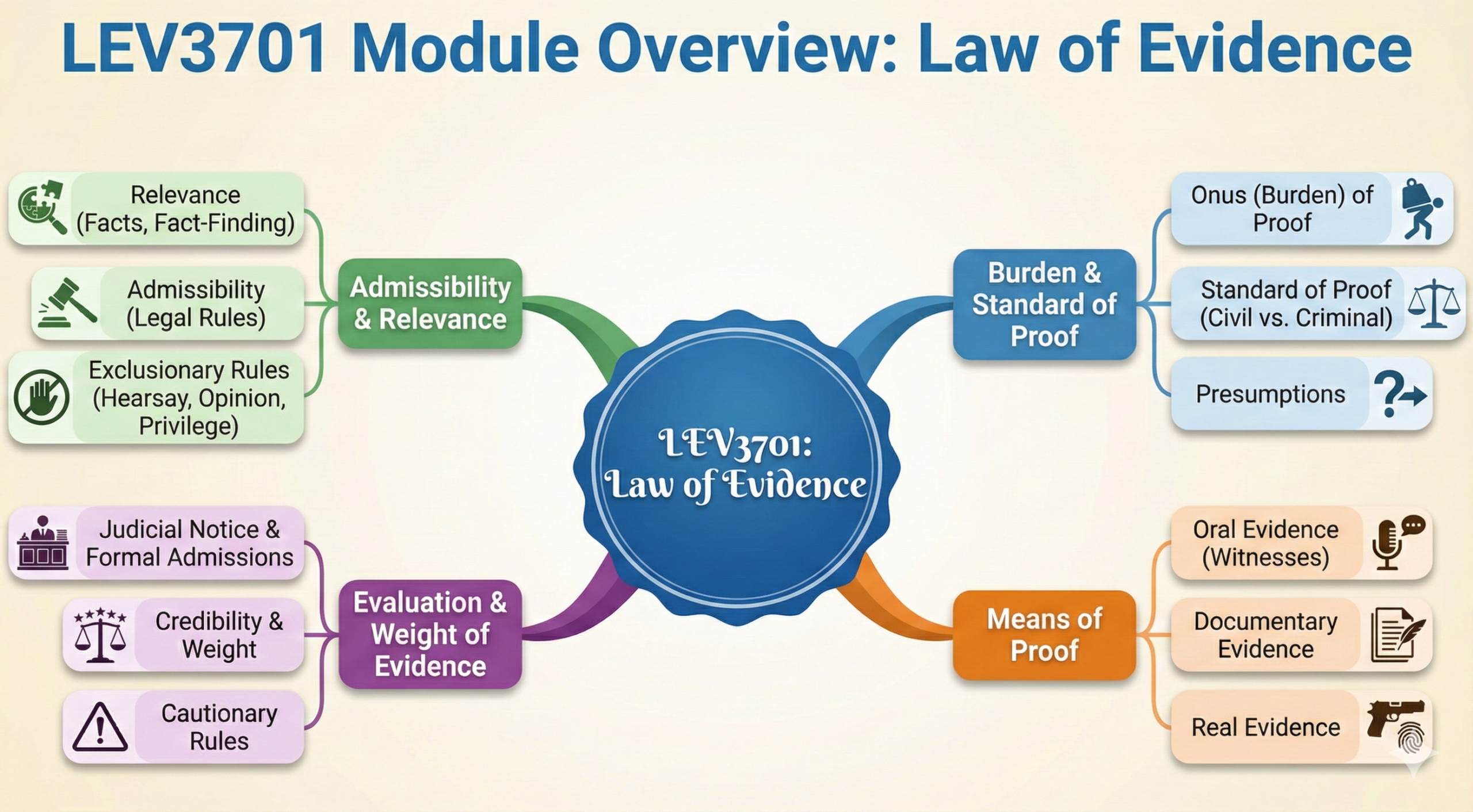
This guide breaks down the “Big 5” pillars of the module.
1. Hearsay Evidence (The Beast)
This is usually 25% of the exam. The general rule is: Hearsay is inadmissible. But the exam is always about the exceptions.
The Definition
Hearsay is evidence where the “probative value” (truth) depends on someone not before the court.
-
Example: “John told me he saw the murder.” (The court needs to test John’s credibility, not yours. Since John isn’t there, it’s hearsay).
The Exception: Section 3(4) of the Law of Evidence Amendment Act
If you want hearsay admitted, you must argue the factors in Section 3(4).
-
Nature of the proceedings: Is it civil or criminal? (Criminal courts are stricter).
-
Nature of the evidence: Is it a casual remark or a sworn affidavit?
-
Purpose: Why do you need it?
-
Probative Value: How strong is it?
-
Reason: Why is the witness not here? (Dead? Overseas? Too scared?).
-
Prejudice: Will it be unfair to the accused?
-
Case Law: You MUST cite S v Ndhlovu. This case established that hearsay can be admitted if it is “in the interests of justice.”
2. Admissions vs. Confessions (The Trap)
This is the most common place students lose marks. You must know the difference.
Admission (Section 219A CPA)
-
Definition: Admitting to facts unfavourable to yourself, but not necessarily admitting guilt to the crime.
-
Example: “Yes, I was at the house, and I held the gun.” (This is an admission, but he might still argue self-defence).
-
-
Requirements: It must be voluntary.
Confession (Section 217 CPA)
-
Definition: An unequivocal acknowledgment of guilt. It leaves no room for a “not guilty” plea.
-
Example: “I murdered him because I hated him.”
-
-
Requirements: Strict! It must be:
-
Freely and voluntarily made.
-
By a person in their sound and sober senses.
-
Without undue influence.
-
Exam Tip: If the confession is made to a Peace Officer (Police), it must be confirmed by a Magistrate or written down, otherwise it is inadmissible.
-
3. Privilege
Some evidence is relevant but excluded because we value the relationship more than the truth.
Legal Professional Privilege
You cannot be forced to disclose what you told your lawyer.
-
Requirements:
-
The advisor must be a professional legal advisor.
-
Communication must be in confidence.
-
It must be for the purpose of legal advice or litigation.
-
-
The Twist: If you tell your lawyer you are planning a future crime, that is not privileged. Privilege only covers past deeds.
4. Constitutional Exclusion (The “Poisoned Tree”)
What happens if the Police find the murder weapon, but they broke down your door without a warrant to get it?
-
Section 35(5) of the Constitution: Evidence obtained by violating the Bill of Rights must be excluded if admitting it would:
-
Render the trial unfair; OR
-
Be detrimental to the administration of justice.
-
-
Exam Tip: Arguing “it’s unfair” isn’t enough. You must weigh the seriousness of the police misconduct against the seriousness of the crime.
Decksh’s Top 3 Tips for a Distinction
Tip 1: Use the “Admissibility Checklist”
When you see a piece of evidence in an exam scenario, run this mental checklist:
-
Is it Relevant? (If no, inadmissible. If yes, continue).
-
Is it Hearsay? (If yes, apply s 3(4)).
-
Is it Opinion? (If yes, is it an expert?).
-
Is it a Confession? (If yes, check s 217).
-
Was it obtained illegally? (If yes, apply s 35(5)).
Tip 2: Don’t Quote Acts, Apply Them
The marker knows what Section 217 says. They want to know if you know how it applies to “Thabo” in the case study.
-
Bad: “Section 217 says a confession must be voluntary.”
-
Good: “Thabo was threatened by the police officer. Therefore, the requirement of ‘freely and voluntarily’ in Section 217 has not been met, and the confession is inadmissible.”
Tip 3: Character Evidence (The Shield)
Remember the “Shield” rule. The prosecution generally cannot bring up the accused’s bad character (previous convictions).
-
The Exception: If the accused attacks the character of the complainant or claims to have a “good character,” the shield falls away, and the prosecution can bring up their past.
Conclusion
LEV3701 is about balancing the truth against fairness. The court wants the truth, but not at the cost of human rights. If you can argue why evidence should be in or out using the Acts and Case Law, you will pass.
Good luck!